Signs of AI writing
The signs of AI writing that hold up are structural rather than decorative. Paragraphs run an even length, sections all resolve the same way, three-part lists pile up, and the closing hedges both ways. Under that sit the habits people notice first: a narrow band of stock words, and punctuation tics like heavy em dash use. All of it turns up in careful human writing too, so no single tell is proof. What counts is how many appear at once, in how short a passage, and whether the writing ever does what a template would not: digress, or use a detail only someone who was there could know.
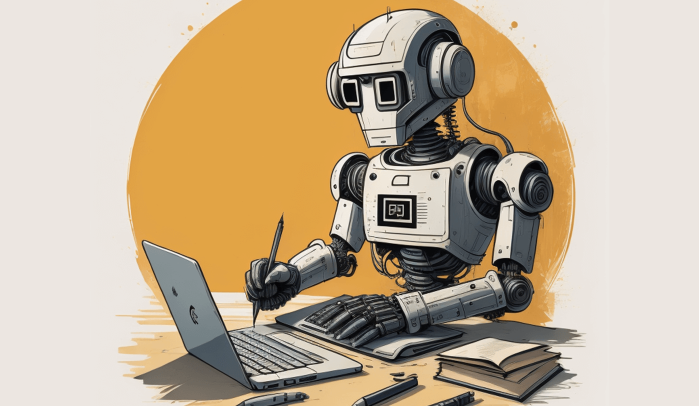
Every tell below comes with where it gets things wrong, and that half matters more: missing machine writing costs you minutes, accusing someone who wrote their own work costs them far more. They also speak only to whether a machine wrote something, not whether it is the low-effort bulk output people mean by AI slop.
Is an em dash a sign of AI writing?
On its own, no. Some models do produce em dashes at a rate most writers never reach. A 2026 preprint that measured twelve models put GPT-4.1 at about 10.6 per thousand words, against 3.2 across its sample of published human essays. But that human sample ran from 0.33 to 17.12 per thousand, a fifty-fold spread: an essayist can out-dash every model in the study, and several current models sit near the bottom of the human range. A high dash count tells you the text is punctuated like edited prose, not who did the punctuating.
The habit is not mysterious. Mustafa Ocal, who studies AI text detection at Florida International University, explains it as prediction rather than taste: the model picks likely next tokens, and the edited English it learned from is full of the character. The preprint points at tuning, not machine writing in general: the dash may be markdown bleeding into prose. Told to write with no markdown formatting, the models mostly dropped headings and bullets, but dash rates moved differently by family. Claude Opus 4.6 fell by about 98%, GPT-4.1 by only 14%, and Meta's Llama models produced none at any point. In November 2025 OpenAI said ChatGPT would obey a custom instruction to stop, though TechCrunch noted the default did not change: you have to ask. A dash test that worked in 2024 gets worse every model release.
Where it gets things wrong. The em dash has been standard punctuation for centuries, and novelists, essayists and subeditors still lean on it. The pushback is coming from working writers who have watched people get pressed to drop the mark, which The Ringer covered in August 2025. Software makes the character for you as well: Word's AutoFormat turns two hyphens into a dash as you type. Judge on punctuation alone and you will accuse the wrong people.
The tidy three
Three adjectives, three clauses, three bullets, three examples, on and on. Wikipedia's signs of AI writing guide, written for its volunteer editors rather than readers, lists overuse of the rule of three among its language signs.
The third item is where to look. In human writing it usually earns its place; in machine writing it is often a synonym of the second, or a word picked for rhythm: scalable, efficient and future-proof. Delete it. If the sentence loses nothing, the shape was doing the work. The tricolon saturates the persuasive English these models learned from, and tuning pushes the same way: a 2025 study of how RLHF changes model output found preference-tuned models produce longer, more repetitive text than base versions.
Where it gets things wrong. The rule of three is taught on purpose, in every writing class and every copywriting course, and speeches run on it. Anyone trained to write to a brief produces three-part lists all day. Sometimes three is how many things there are.
Words that arrive too often
Some vocabulary shows up disproportionately. It is the easiest tell to look for and the weakest: a word count measures style, and style is what a writer can change in an afternoon. Only density carries a signal. One stock word in a paragraph is nothing, a dozen in four paragraphs is something.
Where it gets things wrong. These are ordinary English words, common in formal writing long before 2022, and a second-language English speaker will use several by default. The list expires too: words that marked machine output in 2023 have since been edited out by users, trained out by vendors, or picked up by writers who read model output.
The full list, with the counts and caveats attached, is on our page about the AI words and phrases models overuse.
Structure without a spine
The hardest tell to describe, and the one worth the most attention. Nothing in machine writing costs the writer anything, so nothing in it is load-bearing:
- Paragraphs of near-identical length, as though poured into a mould.
- Every section resolving the same way: real challenges remain, but the outlook is promising.
- Bold everywhere and a heading for everything, so nothing outranks anything.
- Nothing digresses: no aside, no anecdote that fails to make a point, no sentence the writer could not resist.
- Coverage instead of argument: every angle mentioned, none chosen.
- The question restated before it is answered, and the answer summarised again before the next heading.
Wikipedia's guide names versions of the same thing: outline-shaped conclusions about challenges and future prospects, superficial analysis built from present participles, headings containing nothing but other headings.
It is roughly what detectors try to measure. GPTZero's explanation of perplexity and burstiness describes burstiness as how much predictability varies across a document: people swing between plain sentences and surprising ones, model output sits at one level. GPTZero moved off both measures to a trained model in 2023, worth remembering when somebody quotes a perplexity number as a verdict.
Where it gets things wrong. Whole genres are spineless on purpose: textbooks, standard operating procedures, press releases, technical documentation, exam answers and the five-paragraph essay. Editors do it too, evening out paragraph lengths and cutting the digression the writer liked. A nervous student writing to a rubric produces this exact shape. Turnitin lists writing with little structural variation among the cases its own detector gets wrong, which is one reason what a Turnitin AI percentage means is worth knowing before you read one.
A 2026 paper argues these false positives are structural rather than a bug: where some students naturally write like the model, a text-only detector must produce false accusations at a rate set by that overlap, and no engineering removes it. That overlap is why the argument is loudest in schools. Which tools are running there, and what a flag from one is worth, is the subject of our page on the AI detectors schools and colleges use.
What has expired, and what still works
Tells decay once they are named in public; a 2023 checklist is now a way to be confidently wrong. Wikipedia files former giveaways under historical indicators: refusals pasted in with their "as an AI language model" preamble, the "it is important to note" disclaimer, the summary a model appended to every section, and answers that stop mid-sentence. They still turn up, but only in text nobody read before publishing.
What still works is the debris. The same guide catalogues what systems leave when output is pasted without cleaning: ChatGPT's citation placeholders, Gemini's bracketed cite markers, DeepSeek's lenticular brackets, broken links and invented DOIs. Nobody types those on purpose, so they produce almost no false positives. The exception is quotation: an article about AI carries the same debris in its examples, so check what a passage is doing before judging the page.
Do these tells actually prove anything?
No. Every sign on this page is a frequency, not a fingerprint. Each appears in ordinary human writing, several more often in the writing of people who learned English formally, and detectors inherit the problem: a 2023 study of several GPT detectors by Liang and colleagues at Stanford, in the journal Patterns, found they repeatedly classified essays by non-native English writers as machine-generated while classifying native-speaker essays correctly. Human judgement is no better: a 2025 experiment on whether people can learn to spot AI text found readers badly calibrated, their worst errors exactly where they felt most certain, though they improved with immediate feedback. Treat a stack of tells as grounds for a question, never a verdict. Only the process behind the writing settles authorship.
What to do when writing trips every tell
Read the reasons, not the number. A score with no working behind it cannot be argued with, which is the problem for whoever it is about.
- Look at which passages carry the signals. Mixed authorship is normal now, and one flagged paragraph is not a page flagged throughout.
- Ask for process, not a confession: drafts, notes, version history, sources. Someone who wrote a piece can say why the third section exists and what they cut.
- Weigh the cost of being wrong in the direction you are about to be wrong in. The two errors are not the same size.
- Never act on a detector alone. That includes this one.
Paste a passage into the check on the home page. It gives a likelihood and the evidence behind it, so you can decide whether you agree. It judges where the words came from, not whether they are any good, and a high number means your suspicion is reasonable, not that anything is settled.
Last updated 2026-08-17.